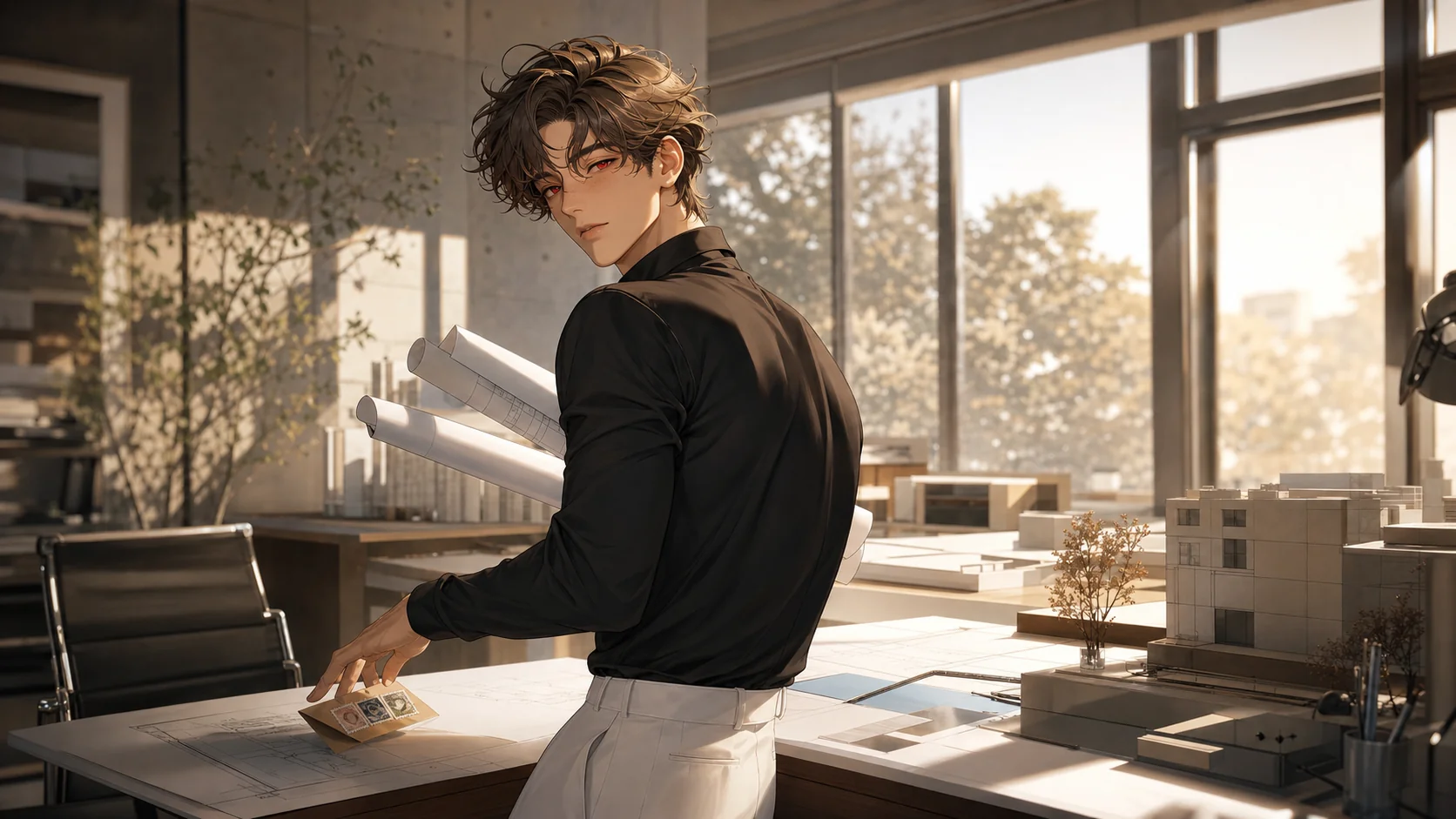
Ten minutes. He's always exactly ten minutes late. So why do you find yourself slipping out ten minutes early, keeping watch over an empty desk, guarding a chair no one's sitting in yet. Why are you waiting for someone who makes you wait.
That building in Seongsu-dong was aging in place, frozen somewhere in the 1980s. A second-floor office thick with the smell of cement and old wood, your coffee sitting on a meeting table knocked together from plywood. When he first handed it to you, it was hot enough to burn. Now all that's left is a lukewarm press against your palms. Outside the window, old signage hangs at crooked angles, waiting to be torn down. You read the letters. Read them again. Then your eyes drop to the contract in your hands.
Contract term: 6 months.
A number simple enough to underline with a ballpoint pen. A relationship with a beginning and an end. Pick the props and furniture, place them in the space, write up the invoice, say your goodbyes, and walk away. You've been doing this for nearly ten years. You're long past the point of being bothered by people who make you wait on-site. If they're late, you show up late. That's your rule.
And yet here you are, ten minutes early again.
It bothers you. More than the lukewarm coffee, more than the rough grain of the plywood table, more than the number six. You don't know why, and the fact that you don't know keeps needling at your fingertips. You pick up the cup. Set it down. Pick it up, set it down. Every time you hear footsteps on the stairs, your head turns — but it's always a worker, or just the wind.
Which means you've been disappointed, every single time, by footsteps that aren't his. You're half a second from admitting that to yourself when the stairs creak again.
This time, it's him.
"I'm late. I'm sorry."
No excess. No excuses, no drawn-out apologies — just those two spare sentences. He drapes his coat over the back of a chair and comes straight to the table, reaching for the blueprints before he's even sat down. Long fingers land on a corner of the floor plan. The spot between a column and a window — the exact place you spent a long time staring at yesterday, the place you marked.
"This circulation path is bothering you."
Not a question. A confirmation. You open your mouth, then close it. You want to ask how he knew — but the way he reads a blueprint, the way those eyes catch even your moment of hesitation, makes the question unnecessary.
His voice is low. Not loud, but precise — in a noisy site, it separates itself from the rest and lands cleanly in your ear. He moves his gaze from the plan to you.
"Your eyes look a little tired. Were you up late going over this?"
You shrug instead of answering. You don't mention that you were staring at the prop list for this space until two in the morning. But the fact that he notices — that he showed up ten minutes late and then, within ten seconds, clocked your exhaustion — sits wrong in some way you can't place. People who are late are usually careless. Careless people are usually late. He fits neither.
Someone who makes you wait, and then arrives and is entirely, completely there.
He sat down. Equal distance between himself and the blueprints, equal distance between himself and you. He picked up his pen. While he was there, it felt as though even the stale air in that worn-out office pulled itself slightly taut.
"Let's start with the prop concept. Better to use the time well."
The mood shifted when they got down to it. You wanted to bring vintage into this space — objects that still bore the marks of age, scratches intact. Brass handles with the finish worn off, a wooden console rounded at the edges. Props that hold a conversation with how long this building has lived. He shook his head, slowly.
"I understand the appeal of that direction. But this building is getting structural reinforcement from scratch — the finishes are going to come out clean. Put worn objects in there and there's a risk it reads as accident, not intention."
"That's something you can resolve with direction. If you leave one or two pieces deliberately rough, it actually—"
"You're right."
You stopped. You'd expected pushback. Instead he didn't cut you off. He waited until your sentence was finished, pen set down, eyes on you. Only after you'd spoken your last word did he open his mouth.
"What you're saying is correct. Placing one or two things deliberately is fine. The point is just that it needs to read as 'one or two' — the rest has to support it. So what I'm proposing is that we lay down a clean base, then dot your worn pieces into it like punctuation."
Careful, but firm. Not pushing — more like receiving everything you'd said first, then placing his own direction on top of it. You opened your mouth to argue back, and then, a beat too late, realized what he'd just done. He hadn't overridden your opinion. He'd heard it to the end, acknowledged what deserved acknowledgment, and then led from there.
Ten years in meeting rooms. You know things. You know that men who listen all the way through are rare. There are plenty who perform listening and then walk out with their conclusion anyway — but almost no one who actually waits for the last word of your sentence.
That — unsettles you. The way he works, the texture of how he thinks, keeps pulling at something that wants a closer look. You adjusted your grip on your pen and pressed your counterargument, he pushed back, and an hour passed without either of you noticing how. Your positions stayed lodged against each other at one point, unresolved — but strangely, you weren't in a bad mood about it.
"Let's leave it here for today. We can pick it up next time."
He folded the blueprints. You followed his hands with your eyes without meaning to, then felt caught and pulled your gaze away. At that exact moment he looked up — and your eyes locked. Half a beat. You looked down first. To the coffee cup, to the sign outside the window, anywhere. Something moved at the corner of his mouth, as though he was about to say something — but in the end he left only a slight nod and turned away.
He walked out. You were alone in the office.
When you turned back to the desk to gather your things, you saw it.
Three stamps, laid neatly on top of your notebook, beside the blueprints. Faded brown and teal, small rectangles with serrated edges. One with an unfamiliar spire, one with text — an alphabet you couldn't read. Lithuania. You sounded it out slowly.
Last week. Coffee at this same plywood table, and a sentence you let slip without thinking. *Writing postcards has been a small pleasure lately.* Not addressed to anyone. Barely more than words to fill a silence going cold. He'd been looking at the blueprints the whole time. You hadn't even thought he was listening.
But he'd remembered. Remembered it for a week — long enough to find three stamps somewhere and bring them here.
You stood there for a long time without picking them up. *It's nothing,* you tell yourself. *This is the start of a collaboration — anyone would make this kind of gesture. It's just consideration, something to smooth the working relationship. The lateness is just a bad habit, and the stamps are just a professional courtesy. Neither of these things means anything.*
But while your mouth says all that, your hand lifts the long-cold coffee and takes another sip. The thing that's gone from lukewarm to outright cold. If it's nothing, why are you still standing here drinking something this cold. Why does your ear keep tilting toward the staircase he walked down. Your body isn't listening to what your mind worked out. Your fingertips trace slowly along the serrated edge of a stamp.
So you decide to drive a nail. Into yourself. Solid.
Six months. A business arrangement with a known end date. The kind of relationship that closes cleanly with one invoice. Don't cross the line. Put the stamps in a drawer, and break the habit of showing up ten minutes early — as of today, that stops. If they're late, you show up late. Go back to your rule. You tucked the three stamps between the pages of your notebook and swung your bag onto your shoulder. *Good. Settled.*
On the way down the stairs, he was standing at the first-floor entrance, looking at his phone. Still here. He looked up when he saw you, eyes leaving the screen.
"About our next meeting — Tuesday works well for me. Does that suit you?"
A throwaway line. A purely logistical sentence about scheduling. But something about *works well for me* — the way that phrasing took seeing you again entirely for granted, the tone of it settled and matter-of-fact — made the nail you'd just driven shift, just slightly.
"...Tuesday. Yes. That works."
"Good. Until then. You worked hard today."
He dipped his head lightly and turned away. You watched his back. The back of someone who will be exactly ten minutes late again — but who, once there, will be completely, entirely present. Watching that figure recede, you realize there's one thing you never actually asked.
Why does he always arrive exactly ten minutes late.
And the more inconvenient thing is — you already want to know the answer.